African Penguin Facts, Species Biology & Evolution
Explore the extraordinary anatomical adaptations, underwater physiology, unique chest spot fingerprints, and survival story of the endangered Spheniscus demersus at Boulders Beach.
African Penguin Biological Profile & Taxonomy
African Penguin Evolutionary Adaptations Matrix
Over millions of years, the African Penguin transformed from a flighted seabird ancestor into an apex underwater hunter engineered to withstand both the freezing waters of the Benguela Current and the blistering African sun.
| Adaptation / Feature | Evolutionary Purpose | Marine Biology Function | How to Observe at Boulders |
|---|---|---|---|
|
🐧 Countershading Camouflage
Pelagic Stealth
|
Bidirectional Pelagic Concealment: Shields swimming penguins from airborne avian predators (kelp gulls, skuas) and deep-water ambush predators (Cape fur seals, bronze whaler sharks, orcas). | Optical Physics In Water: Light filtering down from the sky reflects off the pure white breast, rendering the bird nearly invisible when viewed from below against the bright surface. Conversely, the dense melanin black feathers on the back absorb light, blending seamlessly with the dark ocean abyss when viewed from above. |
Boardwalk Tip:
Look directly down into the turquoise shallows from the Foxy Beach wooden boardwalks as birds cruise beneath the surface. Notice how quickly their black backs vanish against darker kelp.
|
|
🦴 Heavy Solid Bones
Diving Ballast
|
Overcoming Buoyant Lift: Completely eliminates the natural positive buoyancy that prevents terrestrial and flighted birds from diving into deep water. | Non-Pneumatic Osteosclerosis: Unlike flying birds whose hollow, air-filled bones reduce weight, penguins evolved dense, osteosclerotic bone structures. This extra mass acts exactly like a free diver’s lead weight belt, allowing rapid descents to 30m–130m depths with minimal muscular effort. |
Water Entry Observation:
Watch penguins dive off granite boulders at Boulders Beach Cove. They sink into the water column effortlessly without energetic surface kicking.
|
|
🌡️ Pink Eye Gland
Heat Regulation
|
Preventing Fatal Hyperthermia: Allows penguins to thrive on dry, baking African mainland beaches (up to 38°C / 100°F) despite possessing heavy polar-grade plumage. | Supraorbital Heat Radiator: These unfeathered skin patches above each eye orbit are packed with capillary beds. When core body temperature rises, the autonomic nervous system reroutes warm blood through these glands, radiating excess heat into the sea breeze. The hotter the bird, the more intensely pink the patch turns. |
Afternoon Lounging:
Compare penguins resting on hot rocks in the mid-afternoon sun with those emerging from the cold water. The sunbathing birds will display bright, glowing flamingo-pink eyebrows!
|
|
🐟 Serrated Beak & Tongue
Prey Lock
|
Securing Slippery Pelagic Fish: Prevents live, wriggling sardines and anchovies from escaping underwater during high-speed, turbulent maneuvers. | Backward-Facing Papillae: The roof of the mouth and tongue are lined with razor-sharp, backward-pointing keratinized barbs. Combined with a hooked maxillary bill tip exerting over 500 psi of crushing force, seized fish are guided backwards into the esophagus in a one-way conveyor belt. |
Yawning & Braying:
Watch for penguins yawning, braying with open beaks, or feeding begging chicks. With binoculars or a telephoto lens, the spiky fleshy interior of the mouth is clearly visible.
|
|
🪶 Double-Layer Feathers
Hydro-Insulation
|
Thermal Barrier in 10°C Waters: Insulates vital organs against deadly hypothermia during 10-hour foraging excursions in cold Benguela Current upwellings. | 70+ Feathers Per Square Inch: Triple the density of flight birds. Stiff, curved outer contour feathers overlap like roof shingles, completely sealing off water. Beneath lies a downy underlayer trapping a microscopic cushion of air against warm skin. The bird conditions this suit with wax-oil from its uropygial preening gland. |
Preening Rituals:
Penguins spend up to 25% of their daylight hours on the beach meticulously preening. Watch them rub their bills on their tail base gland, then vigorously coat their white chest feathers.
|
|
👁️ Transparent Third Eyelid
Diving Goggles
|
Ocular Protection & Precision Optics: Protects delicate corneal tissue from abrasive saltwater, suspended sand, and water friction during 20 km/h underwater sprints. | Nictitating Membrane: A translucent, horizontally sliding membrane that flicks across the eye from the inner nasal corner. It acts like custom-fitted optical diving goggles, maintaining clear binocular depth perception and target tracking without impairing vision in murky surf. |
Emergence from Surf:
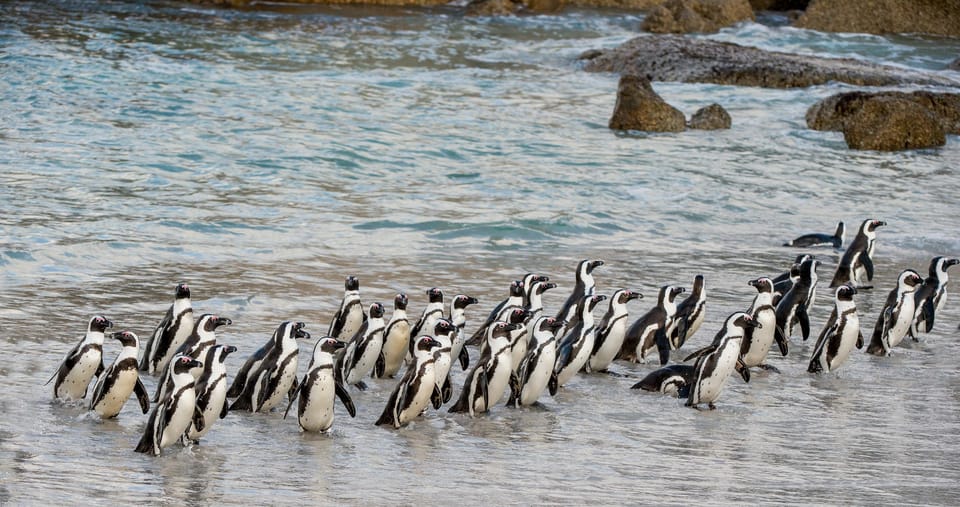
As penguins waddle out of the surf onto Boulders Beach, look closely at their eyes. You will see a pale, transparent sheet flick across the eye to clear sand and ocean droplets.
|
Why Are There Penguins in Warm Africa? The Benguela Current Upwelling
A common myth is that penguins only inhabit the frozen wastes of Antarctica. In reality, out of 18 penguin species worldwide, only 2 reside strictly on the Antarctic continent (the Emperor and Adélie). The remaining 16 species inhabit temperate, sub-Antarctic, or even equatorial islands.
The African Penguin thrives at the southern tip of Africa due entirely to the Benguela Current System—one of the world’s four great eastern boundary upwelling biomes. Cold water originating in the sub-Antarctic Southern Ocean flows northward along South Africa's Atlantic coastline.
Fierce south-easterly summer winds (the famous "Cape Doctor") push surface coastal waters offshore through Ekman transport. This forces icy (9°C–14°C), oxygen-rich, nitrate-and-phosphate-dense bottom water to surge up to the sunlit surface. This oceanic upwelling powers colossal phytoplankton blooms, supporting billions of nutrient-packed Sardinops sagax (pilchards) and Engraulis encrasicolus (anchovies)—the super-calorie diet essential for penguin survival.
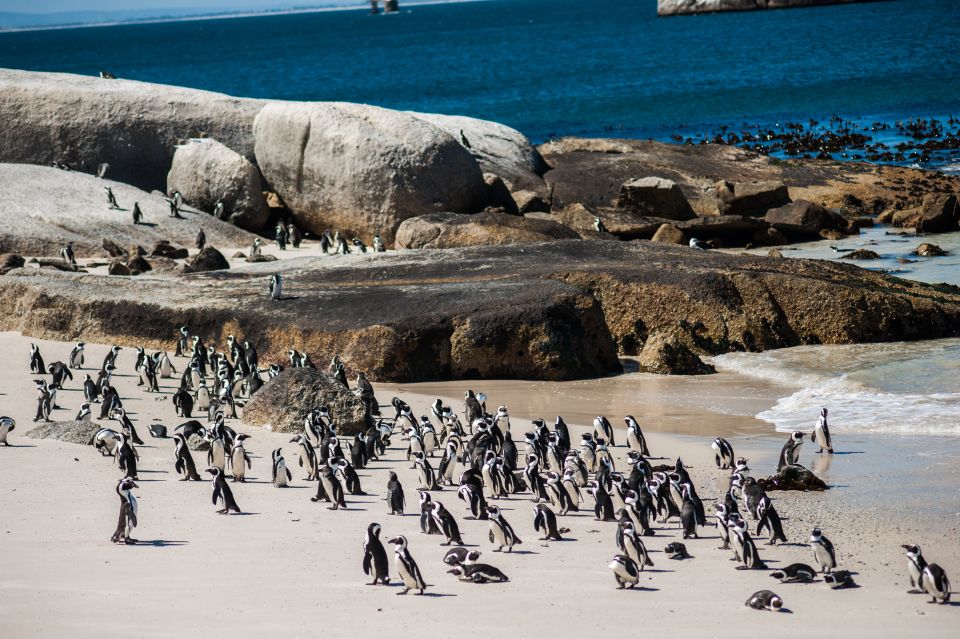
Why Simon's Town is Unique: While the open Atlantic coast suffers ferocious ocean swells, Simon's Town is sheltered within False Bay. Enormous two-billion-year-old granite boulders create calm coves protected from rough seas, providing safe mainland nurseries for chicks just miles from open feeding grounds.
Chest Spot "Fingerprints" & Lifelong Monogamy
Beyond their aquatic prowess, African Penguins exhibit sophisticated social structures, high-fidelity partnership bonds, and individualized biological signatures that have transformed modern seabird conservation.
Chest Spot "Fingerprints"
Every single African Penguin is born with a distinct, unrepeatable distribution of black feather speckles across its snow-white chest and belly. Much like human fingerprints or zebra stripes, no two penguins in the world share the exact same pattern.
Historically, researchers fitted metal bands around penguins' flippers to track them. However, extensive studies revealed metal bands increased hydraulic drag by up to 24%, exhausting birds and lowering survival rates.
Today, organizations like SANCCOB and university researchers use AI computer vision and high-resolution camera traps. Software instantly identifies individual penguins from their unique chest spots, tracking longevity, molts, and breeding success 100% non-invasively!
Lifelong Monogamy & Parenting
African Penguins are intensely monogamous. Once a pair bonds through mutual courtship displays and synchronized vocalizations, they remain together for life. Annual divorce rates hover below 10%, almost exclusively occurring if a pair experiences multi-year nest failures.
Parenting is an exact 50/50 partnership. Females lay a clutch of 2 chalky-white eggs in a shaded burrow or under granite boulders. Both parents share the grueling 38 to 42-day incubation period, taking turns sitting on the eggs while the other spends days foraging far offshore.
For the first 30 days after hatching, tiny chicks cannot regulate their body temperature. Parents alternate 24-hour guard shifts, regurgitating partially digested anchovy soup until chicks join communal nursery "crèches."
The 'Jackass' Braying Vocalization Decoded
When 17th-century European mariners first rounded the Cape of Good Hope, they were astonished to hear what sounded like herds of frantic donkeys echoing from the rocky cliffs. Learn why these seabirds sound like donkeys and how they communicate across three distinct vocal categories:
🗣️ The Contact Call ("Yelp")
A short, sharp, single-syllable acoustic bark lasting just 0.1 to 0.3 seconds. Penguins emit this call while swimming in murky surf or returning to the colony at dusk to announce their presence and pinpoint their mate amidst thousands of shouting neighbors.
Context: Surf landings, flock cohesion, locating partner
🫏 The Display Bray ("Donkey Bray")
The legendary call that earned them the "Jackass" moniker. The bird throws its head straight upward, arches its neck, pumps its flippers rhythmically, and unleashes alternating inhalant barks and explosive exhalant brays reaching up to 105 decibels!
Context: Mate attraction, pair bonding, burrow dominance
⚠️ Aggressive Bark & Hiss
A low, guttural, vibrating grunt accompanied by rapid beak snapping and sharp lunging hisses. Used to warn off intruding penguins, predatory kelp gulls, or visitors stepping too close to active nests along boardwalk boundaries.
Context: Burrow trespass, egg defense, predator deterrence
African Penguin vs. Other Spheniscus Cousins
All four living species in the genus Spheniscus (the "Banded Penguins") share characteristic black-and-white facial bands and inhabit temperate or warm-water regions. Here is how South Africa’s African Penguin compares with its South American and equatorial relatives:
| Species & Genus | Native Range & Habitat | Conservation Status | Key Visual Markings | Ocean Temp & Currents | Primary Diet & Dives |
|---|---|---|---|---|---|
|
🇿🇦 African Penguin
Spheniscus demersus
Colony Star ⭐
|
South Africa & Namibia Mainland Simon's Town (Boulders Beach), Stony Point (Betty's Bay), and 27 offshore islands. |
🔴 Endangered <10,000 breeding pairs left |
Single black horseshoe breast band, prominent pink supraorbital eye glands, unique chest spot fingerprint pattern. |
10°C – 18°C Benguela Current cold coastal upwelling system. |
Sardines & Cape anchovies. Max dive: 130m (avg 30m). |
|
🇦🇷 Magellanic Penguin
Spheniscus magellanicus
|
Southern Chile, Argentina & Falkland Islands Patagonian rocky coasts and sub-polar burrowing islands. |
🟡 Near Threatened ~1.1 to 1.6 million pairs |
Double black breast band (two distinct dark neck collars). Noticeably larger body size (4.0–5.0 kg). |
6°C – 14°C Falkland & Humboldt cold sub-Antarctic currents. |
Sprats, juvenile squid, krill. Max dive: 100m. |
|
🇵🇪 Humboldt Penguin
Spheniscus humboldti
|
Coastal Peru & Northern Chile Guano-covered arid Pacific islands and sea cliffs. |
🟠 Vulnerable ~20,000 to 30,000 birds |
Single broad black band, conspicuous fleshy pink border around bill base, chin, and lores. |
14°C – 20°C Humboldt Current nutrient upwelling zone. |
Peruvian anchoveta, silversides. Max dive: 54m. |
|
🇪🇨 Galapagos Penguin
Spheniscus mendiculus
|
Galapagos Archipelago (Equator) Isabela and Fernandina Islands. Only penguin found north of the Equator! |
🔴 Endangered <1,200 breeding birds |
Smallest Spheniscus species (under 2.5 kg). Thin white facial stripe, often faint or broken breast band. |
17°C – 28°C Equatorial waters cooled by the Cromwell Current upwelling. |
Small mullets, sardines, salemas. Max dive: 30m (shallow feeder). |
Watch African Penguins in Action: Underwater Flight & Biology
See how African Penguins utilize their dense skeletal ballast and streamlined paddle wings to achieve underwater "flight" at 20 km/h in this documentary feature on South Africa's coastal colonies:
Choose Your Boulders Beach Penguin Experience
Whether you want a simple official entrance ticket voucher or a stress-free guided day excursion from Cape Town with private transport, compare the top-rated 2026 options below:
|
Compare Options
Key Parameters
|
🎫 Entry Ticket
GetYourGuide Verified
Boulders Penguin Colony Entry Ticket |
🚐 Half-Day Tour
GetYourGuide Verified
Penguin Watching Half-Day Tour |
👑 4.9★ Bestseller

Viator Top Pick
Cape of Good Hope & Boulders Penguins Day Tour |
|---|---|---|---|
|
Price (Per Person)
|
€25.26
/ ~$27.50 USD
per person (direct admission)
|
€31.86
/ ~$35.00 USD
per person (guided transport)
|
$57.89
/ ~€53.50 EUR
per person (full day tour, |
|
Park Entry Included?
|
✅ INCLUDED
Official SANParks ticket voucher
|
❌ EXCLUDED
R245 (~$13 USD) payable at gate
|
❌ EXCLUDED
Payable at gates: Boulders R245 + Cape Point R440
|
|
Duration & Schedule
|
1 – 2 hours
Flexible self-guided pace (open daily)
|
4.5 – 5 hours
Morning or afternoon hotel departure
|
8 hours
Full-day comprehensive Peninsula circuit
|
|
Transport & Pickup
|
Self-Drive / Uber / Taxi
Direct access at Simon's Town entrance
|
✅ Hotel Pickup & Drop-off
Air-conditioned minivan from Cape Town
|
✅ Hotel Pickup & Drop-off
Air-conditioned vehicle & bottled water
|
|
Key Highlights
|
|
|
|
|
Rating & Reviews
|
|||
|
Cancellation Policy
|
✓ Free 24h Cancellation
100% full refund guarantee
|
✓ Free 24h Cancellation
100% full refund guarantee
|
✓ Free 24h Cancellation
100% full refund guarantee
|
|
Direct Booking
|
Book Ticket Online → | Check Availability → | Book on Viator (4.9★) → |
African Penguin Biology & Visiting FAQs
The penguins at Boulders Beach are African Penguins (Spheniscus demersus), the only penguin species that breeds on the African continent. They belong to the banded penguin genus Spheniscus and are characterized by a single black breast band, pink supraorbital eyebrow glands, and distinctive chest spot patterns.
African Penguins were historically nicknamed "Jackass Penguins" by 17th-century European explorers because their loud, rhythmic display vocalization sounds strikingly like a braying donkey. The low-frequency call travels exceptionally well through coastal wind, turbulent surf, and dense coastal fynbos brush.
Yes. The African Penguin is classified as Endangered on the IUCN Red List. In the early 1900s, millions of breeding pairs inhabited the southern African coastline. Today, fewer than 10,000 breeding pairs remain worldwide due to commercial overfishing of sardines and anchovies, climate change shifting fish stocks, oil spills, and historical guano harvesting. Dedicated rehabilitation centers such as SANCCOB lead frontline rescue, hand-rearing of abandoned chicks, and oil-spill response. The Boulders Beach colony in Simon's Town protects approximately 2,100 birds.
African Penguins can sprint underwater at speeds of up to 20 km/h (12.4 mph) when pursuing prey or evading predators like Cape fur seals. While average feeding dives reach depths of 30 to 35 meters and last 1 to 2 minutes, recorded maximum dives exceed 130 meters in the deeper waters of False Bay.
Yes. African Penguins practice lifelong monogamy, maintaining an annual mate fidelity rate between 80% and 90%. Breeding pairs reunite annually at the exact same nesting burrow in Simon's Town, sharing 38 to 42 days of egg incubation equally and taking turns hunting fish to feed their chicks.
Strictly no. Touching, feeding, pursuing, or approaching within 3 meters (10 feet) of any penguin is illegal under SANParks conservation regulations. African Penguins possess sharp, razor-serrated beaks capable of exerting over 500 psi of pressure and can inflict deep, severe, easily infected lacerations.
The pink patch above each eye is a specialized thermoregulation gland. In hot weather, the bird's nervous system redirects warm core blood to the surface capillaries in this unfeathered skin, radiating heat into the cool ocean breeze. The hotter the bird gets, the more vivid and glowing pink the patch appears.
The irregular black feather spots scattered across an African Penguin's white breast are genetically unique to each individual bird, functioning exactly like a human fingerprint. Marine biologists use digital photograph recognition to identify and track individual penguins across their 15-20 year lifespan without needing invasive metal flipper bands.
An online pre-booked ticket (€25.26 / ~$27.50 USD) grants direct self-guided turnstile admission with guaranteed entry during daily visitor capacity caps. Guided tours from Cape Town (€31.86 to $57.89 USD) include round-trip hotel pickup, air-conditioned transport along scenic Chapman's Peak Drive, professional guides, and Cape Point National Park stops.